6.6: Scheduling and Policing Mechanisms
In the previous
section, we identified the important underlying principles in providing
quality-of-service (QoS) guarantees to networked multimedia applications.
In this section, we will examine various mechanisms that are used to provide
these QoS guarantees.
6.6.1: Scheduling MechanismsRecall from our discussion in Section 1.6 and Section 4.6, that packets belonging to various network flows are multiplexed together and queued for transmission at the output buffers associated with a link. The manner in which queued packets are selected for transmission on the link is known as the link scheduling discipline. We saw in the previous section that the link scheduling discipline plays an important role in providing QoS guarantees. Let us now consider several of the most important link scheduling disciplines in more detail.First-In-First-Out (FIFO) Figure 6.23 shows the queuing model abstractions for the First-in-First-Out (FIFO) link scheduling discipline. Packets arriving at the link output queue are queued for transmission if the link is currently busy transmitting another packet. If there is not sufficient buffering space to hold the arriving packet, the queue's packet discarding policy then determines whether the packet will be dropped ("lost") or whether other packets will be removed from the queue to make space for the arriving packet. In our discussion below we will ignore packet discard. When a packet is completely transmitted over the outgoing link (that is, receives service) it is removed from the queue.
The FIFO scheduling discipline (also known as First-Come-First-Served--FCFS) selects packets for link transmission in the same order in which they arrived at the output link queue. We're all familiar with FIFO queuing from bus stops (particularly in England, where queuing seems to have been perfected) or other service centers, where arriving customers join the back of the single waiting line, remain in order, and are then served when they reach the front of the line. Figure 6.24 shows an example of the FIFO queue in operation. Packet arrivals are indicated by numbered arrows above the upper timeline, with the number indicating the order in which the packet arrived. Individual packet departures are shown below the lower timeline. The time that a packet spends in service (being transmitted) is indicated by the shaded rectangle between the two timelines. Because of the FIFO discipline, packets leave in the same order in which they arrived. Note that after the departure of packet 4, the link remains idle (since packets 1 through 4 have been transmitted and removed from the queue) until the arrival of packet 5.
Priority Queuing Under priority queuing, packets arriving at the output link are classified into one of two or more priority classes at the output queue, as shown in Figure 6.25. As discussed in the previous section, a packet's priority class may depend on an explicit marking that it carries in its packet header (for example, the value of the Type of Service (ToS) bits in an IPv4 packet), its source or destination IP address, its destination port number, or other criteria. Each priority class typically has its own queue. When choosing a packet to transmit, the priority queuing discipline will transmit a packet from the highest priority class that has a nonempty queue (that is, has packets waiting for transmission). The choice among packets in the same priority class is typically done in a FIFO manner.
Figure 6.26 illustrates the operation of a priority queue with two priority classes. Packets 1, 3, and 4 belong to the high-priority class and packets 2 and 5 belong to the low-priority class. Packet 1 arrives and, finding the link idle, begins transmission. During the transmission of packet 1, packets 2 and 3 arrive and are queued in the low- and high-priority queues, respectively. After the transmission of packet 1, packet 3 (a high-priority packet) is selected for transmission over packet 2 (which, even though it arrived earlier, is a low-priority packet). At the end of the transmission of packet 3, packet 2 then begins transmission. Packet 4 (a high-priority packet) arrives during the transmission of packet 3 (a low-priority packet). Under a so-called non-preemptive priority queuing discipline, the transmission of a packet is not interrupted once it has begun. In this case, packet 4 queues for transmission and begins being transmitted after the transmission of packet 2 is completed.
Round Robin and Weighted Fair Queuing (WFQ) Under the round robin queuing discipline, packets are again sorted into classes, as with priority queuing. However, rather than there being a strict priority of service among classes, a round robin scheduler alternates service among the classes. In the simplest form of round robin scheduling, a class 1 packet is transmitted, followed by a class 2 packet, followed by a class 1 packet, followed by a class 2 packet, and so on. A so-called work-conserving queuing discipline will never allow the link to remain idle whenever there are packets (of any class) queued for transmission. A work-conserving round robin discipline that looks for a packet of a given class but finds none will immediately check the next class in the round robin sequence. Figure 6.27 illustrates the operation of a two-class round robin queue. In this example, packets 1, 2, and 4 belong to class 1, and packets 3 and 5 belong to the second class. Packet 1 begins transmission immediately upon arrival at the output queue. Packets 2 and 3 arrive during the transmission of packet 1 and thus queue for transmission. After the transmission of packet 1, the link scheduler looks for a class-2 packet and thus transmits packet 3. After the transmission of packet 3, the scheduler looks for a class-1 packet and thus transmits packet 2. After the transmission of packet 2, packet 4 is the only queued packet; it is thus transmitted immediately after packet 2.
A generalized abstraction of round robin queuing that has found considerable use in QoS architectures is the so-called weighted fair queuing (WFQ) discipline [Demers 1990; Parekh 1993]. WFQ is illustrated in Figure 6.28. Arriving packets are again classified and queued in the appropriate per-class waiting area. As in round robin scheduling, a WFQ scheduler will again serve classes in a circular manner--first serving class 1, then serving class 2, then serving class 3, and then (assuming there are three classes) repeating the service pattern. WFQ is also a work-conserving queuing discipline and thus will immediately move on to the next class in the service sequence upon finding an empty class queue.
WFQ differs
from round robin in that each class may receive a differential amount
of service in any interval of time. Specifically, each class, i,
is assigned a weight, wi. Under WFQ, during any interval
of time during which there are class i packets to send, class i
will then be guaranteed to receive a fraction of service equal to wi/( 6.6.2: Policing: The Leaky BucketIn Section 6.5, we also identified policing, the regulation of the rate at which a flow is allowed to inject packets into the network, as one of the cornerstones of any QoS architecture. But what aspects of a flow's packet rate should be policed? We can identify three important policing criteria, each differing from the other according to the time scale over which the packet flow is policed:
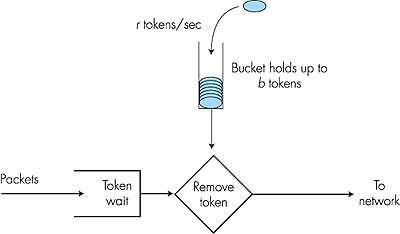
Let us now consider how the leaky bucket can be used to police a packet flow. Suppose that before a packet is transmitted into the network, it must first remove a token from the token bucket. If the token bucket is empty, the packet must wait for a token. (An alternative is for the packet to be dropped, although we will not consider that option here.) Let us now consider how this behavior polices a traffic flow. Because there can be at most b tokens in the bucket, the maximum burst size for a leaky-bucket-policed flow is b packets. Furthermore, because the token generation rate is r, the maximum number of packets that can enter the network of any interval of time of length t is rt + b. Thus, the token generation rate, r, serves to limit the long-term average rate at which the packet can enter the network. It is also possible to use leaky buckets (specifically, two leaky buckets in series) to police a flow's peak rate in addition to the long-term average rate; see the homework problems at the end of this chapter. Leaky Bucket + Weighted Fair Queuing Provides Provable Maximum Delay in a Queue In Sections 6.7 and 6.9 we will examine the so-called Intserv and Diffserv approaches for providing quality of service in the Internet. We will see that both leaky bucket policing and WFQ scheduling can play an important role. Let us thus close this section by considering a router's output that multiplexes n flows, each policed by a leaky bucket with parameters bi and ri, i = 1, . . . , n, using WFQ scheduling. We use the term "flow" here loosely to refer to the set of packets that are not distinguished from each other by the scheduler. In practice, a flow might be comprised of traffic from a single end-to-end connection (as in Intserv) or a collection of many such connections (as in Diffserv), see Figure 6.30.
Recall from
our discussion of WFQ that each flow, i, is guaranteed to receive
a share of the link bandwidth equal to at least R · wi/(
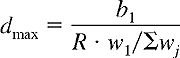
The justification
of this formula is that if there are b1 packets in the
queue and packets are being serviced (removed) from the queue at a rate
of at least R · w1/ ( |


 wj),
where the sum in the denominator is taken over all classes that also have
packets queued for transmission. In the worst case, even if all classes
have queued packets, class i will still be guaranteed to receive
a fraction wi/(
wj),
where the sum in the denominator is taken over all classes that also have
packets queued for transmission. In the worst case, even if all classes
have queued packets, class i will still be guaranteed to receive
a fraction wi/(